System Architecture

Artexion is an execution operating system designed to bridge the gap between probabilistic AI reasoning and deterministic real-world execution. This document outlines the architectural principles and system design.

01

Architecture Overview

Artexion provides deterministic execution infrastructure for AI systems, transforming probabilistic reasoning into controlled, traceable action.

Artexion operates as a dedicated execution layer between AI models and real-world systems. It accepts probabilistic intent from AI reasoning systems and transforms it into deterministic execution plans with explicit state management, safety boundaries, and comprehensive traceability.

The system is built on the principle that execution is a systems problem, not a model problem. While AI models excel at reasoning, they lack the architectural properties required for reliable execution: determinism, state persistence, error boundaries, and audit trails.
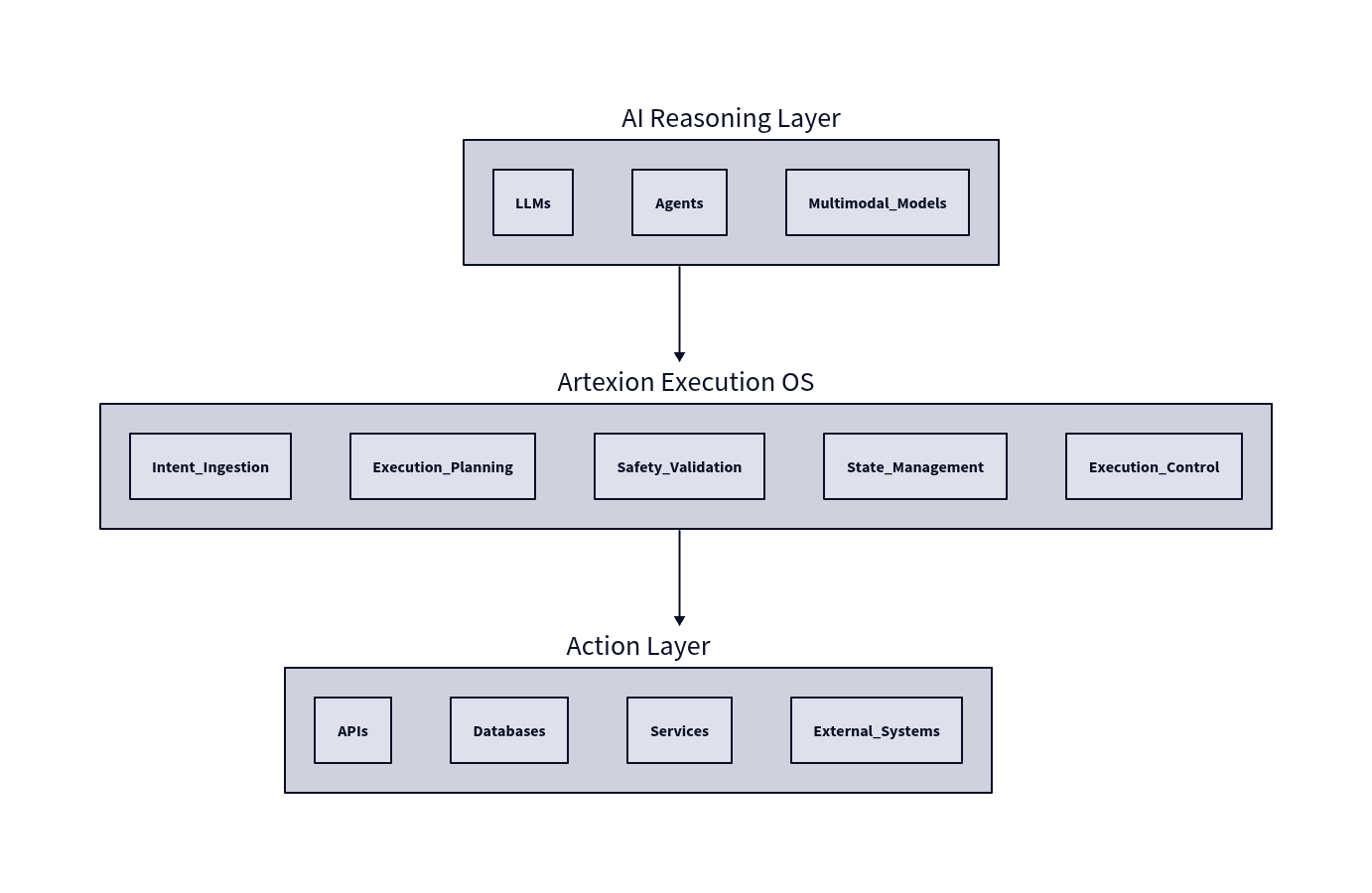
[DIAGRAM: Layered Architecture (AI Reasoning | Artexion OS | Action Layer)]

Three-layer architecture separating reasoning, execution, and action

Artexion's architecture is designed to provide what language models cannot: deterministic control, explicit state management, and supervised actuation. It transforms AI from an advisory system into an operational system.

02

Where Artexion Sits in the Stack

The execution operating system layer between reasoning and action

Modern AI stacks contain sophisticated reasoning layers but lack dedicated execution infrastructure. Artexion fills this gap by providing a deterministic execution layer that sits between AI reasoning systems and real-world action interfaces.

1

AI Reasoning Layer

Probabilistic generation of intent, plans, and analysis. This includes language models, multimodal systems, and specialized reasoning engines. Output is statistical, non-deterministic, and lacks execution guarantees.

2

Artexion Execution OS

Deterministic execution infrastructure that transforms AI intent into controlled action. Provides state management, safety validation, execution planning, and comprehensive traceability. Enforces system invariants and execution boundaries.

3

Action Layer

Real-world systems, APIs, databases, services, and physical interfaces that require deterministic, traceable execution. These systems demand exactness, consistency, and auditability that probabilistic AI cannot provide directly.

This architectural separation ensures that AI systems can reason without being constrained by execution requirements, while execution can be deterministic without limiting reasoning capabilities. Each layer operates according to its appropriate constraints and guarantees.

03

The Artexion Execution Pipeline

From probabilistic intent to deterministic execution

Artexion transforms AI-generated intent into controlled execution through a multi-stage pipeline. Each stage introduces determinism, validation, and observability while maintaining separation between reasoning and execution concerns.

[DIAGRAM: Execution Flow Pipeline (Intent → Plan → Validate → Execute → Trace)]

End-to-end execution pipeline with deterministic transformations at each stage

1

Intent Ingestion

AI-generated intent is captured with full context. The system accepts probabilistic output while preparing for deterministic transformation.

2

Execution Planning

Intent is transformed into concrete execution plans with explicit steps, dependencies, and rollback definitions. Planning introduces determinism.

3

Safety Validation

Plans are validated against system constraints, security policies, and operational boundaries. Invalid plans are rejected or corrected.

4

Controlled Execution

Validated plans are executed with state management, error handling, and progress tracking. Execution is deterministic and supervised.

5

Comprehensive Tracing

Every execution step, state transition, and outcome is recorded with full context. Traces enable inspection, debugging, and audit.

This pipeline ensures that probabilistic AI output is transformed into deterministic execution with appropriate safety boundaries and observability at every stage. Each transformation reduces uncertainty while increasing control and traceability.

04

System Primitives

Core abstractions that define the execution operating system

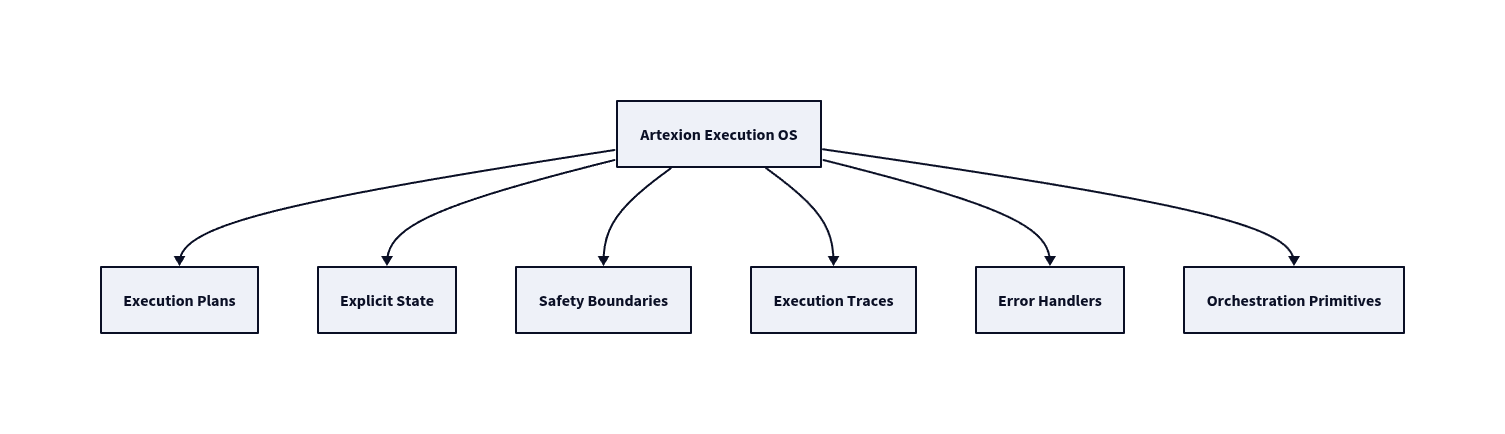
Artexion is built around a set of system primitives that define how execution is structured, controlled, and observed. These primitives provide the foundation for deterministic AI execution.

Execution Plans

Structured representations of executable workflows with defined steps, dependencies, error handlers, and rollback procedures. Plans transform probabilistic intent into deterministic action sequences.

Explicit State

Persistent, structured system state that survives across execution steps and system restarts. Provides continuity for long-running processes and enables recovery mechanisms.

Safety Boundaries

Validation rules, permission systems, and operational constraints that govern what actions can be executed. Boundaries are enforced independently of AI reasoning.

Execution Traces

Immutable records of execution history containing every step, state change, and outcome. Traces provide full auditability and enable forensic debugging.

Error Handlers

Explicit mechanisms for detecting, containing, and recovering from execution failures. Handlers define fallback strategies and graceful degradation paths.

Orchestration Primitives

Coordination mechanisms for distributed execution across multiple nodes, including parallel processing, load balancing, and resource management.

These primitives work together to provide the architectural foundation for reliable AI execution. They enable systems that can maintain long-running processes, recover from failures, enforce safety constraints, and provide complete audit trails.

05

Design Principles

Architectural invariants and system guarantees

Artexion's architecture is governed by a set of design principles that define system behavior and guarantee execution properties. These principles ensure the system provides deterministic, traceable, and safe execution.

Deterministic Execution

Identical inputs produce identical execution paths. The system eliminates probabilistic behavior in execution while preserving it in reasoning.

Explicit Over Implicit

All system state, execution steps, and boundaries must be explicitly defined. Implicit behavior derived from training data is eliminated.

Separation of Concerns

Reasoning remains probabilistic and creative. Execution becomes deterministic and controlled. These domains are architecturally separated.

Complete Observability

Every execution step is recorded with full context. System behavior is always inspectable, debuggable, and auditable.

Failure Boundaries

Errors are contained within defined boundaries with explicit recovery mechanisms. Failures cannot propagate uncontrollably.

Supervised Actuation

AI systems propose actions. Artexion validates, plans, and executes them. Execution is always supervised by infrastructure.

These principles ensure that Artexion provides execution infrastructure suitable for enterprise environments, regulated industries, and safety-critical applications where reliability and auditability are non-negotiable requirements.

06

What Execution Infrastructure Enables

Architectural capabilities unlocked by deterministic execution

The Artexion architecture enables capabilities that are currently impossible or unsafe with direct AI execution. By providing deterministic execution infrastructure, it unlocks new categories of AI-driven systems.

Long-Running AI Processes

AI systems that maintain state across days, weeks, or months of operation with guaranteed continuity and recovery mechanisms.

Auditable AI Operations

Complete execution trails that satisfy regulatory requirements, compliance audits, and forensic investigations of AI behavior.

Safety-Critical Execution

AI systems that can safely control physical systems, financial transactions, or medical devices with guaranteed safety boundaries.

Distributed AI Coordination

Multiple AI systems working together on complex workflows with coordinated execution, shared state, and synchronized outcomes.

Reproducible AI Behavior

Identical execution outcomes from identical inputs, enabling testing, debugging, and certification of AI-driven systems.

Governed AI Autonomy

AI systems that can operate autonomously within defined policy boundaries, with human oversight at appropriate control points.

These capabilities represent the next generation of AI systems—those that move beyond conversation and analysis to become reliable operational components of enterprise infrastructure.

07

Execution Infrastructure for AI Systems

Building the next generation of reliable AI-driven systems

Artexion provides the missing execution layer between AI reasoning and real-world action. Its architecture is designed specifically for the requirements of enterprise AI systems: determinism, traceability, safety, and control.

The system enables organizations to build AI-driven systems that can be trusted with real-world execution—systems that maintain state across extended operations, provide complete audit trails, enforce safety boundaries, and recover gracefully from failures.

Not better answers. Reliable execution.

Artexion's purpose is to provide the execution infrastructure necessary for AI systems that require deterministic, traceable, and controlled operation in production environments.

For engineering teams building AI systems where execution correctness matters more than text quality, Artexion provides the architectural foundation for reliable, auditable, and safe operation.